ODOO logo ODOO Partner

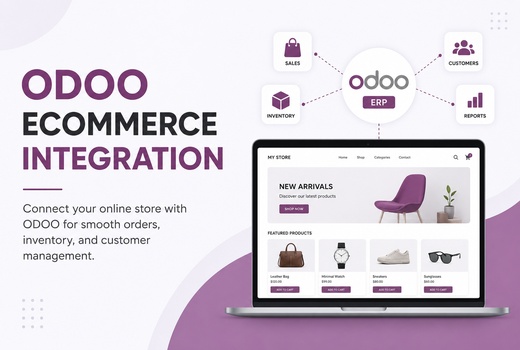
Odoo eCommerce Integration Services for Australia

Logo Desire provides Odoo eCommerce integration for Australian businesses that need an open source, fully integrated system for online orders, product data, stock, payments, shipping, CRM, accounting, point of sale and ERP reporting.

We connect ODOO with websites, Shopify, WooCommerce, marketplaces, custom stores and point of sale workflows so your team can manage sales, inventory, invoices, fulfilment and customer communication without repeating the same data across different tools.

✓ Shopify, WooCommerce & Website Sync ✓ Product, Order & Inventory Automation ✓ Australia & Global Support ✓ 4.9/5 Client Feedback

What Is Odoo eCommerce Integration?

Odoo eCommerce integration connects an online store, marketplace or B2B portal with Odoo ERP so product, customer, order, payment, inventory, shipping and accounting records move through one controlled workflow. Australian retailers, wholesalers, distributors and online brands use this connection to reduce manual entry, prevent stock errors and give each team access to consistent operational data.

Logo Desire maps your catalogue, sales channels, warehouse structure, GST requirements, payment providers, delivery partners and reporting priorities before configuration. Whether you sell through Odoo, Shopify, WooCommerce, Magento, Amazon or a custom portal, the integration is designed around your operating model rather than a generic connector template.

Why Australian Businesses Need Odoo eCommerce Integration

Growing online businesses often use one platform for the storefront, another for inventory, separate shipping software and spreadsheets for exceptions. This fragmented structure creates duplicate customer records, delayed invoices, overselling and slow dispatch as order volume increases.

A connected Odoo environment converts online transactions into structured sales, warehouse, finance and customer-service workflows. Real-time stock synchronization can update availability after an order, return, receipt or warehouse transfer. Automated order fulfillment can create delivery orders, reserve stock and pass shipment details to the selected carrier.

The result is a practical inventory management software environment for GST-aware domestic sales, international orders, multiple warehouses and consolidated reporting.

Connected operations can include:

  • Products, variants, SKUs, prices and category records.
  • Customers, orders, discounts, taxes and payment references.
  • Stock reservations, returns, transfers and replenishment.
  • Picking, packing, shipping labels and tracking updates.
  • Invoices, refunds, credit notes and reconciliation.
  • Sales, margin, stock and fulfilment reporting.

Odoo Commerce Support Across Australia and International Markets

Logo Desire provides remote consultation, implementation and support for Australian businesses and international teams operating connected commerce channels.

Australia UK USA Canada Tanzania Uganda Rwanda Ethiopia Kenya Pakistan UAE Saudi Arabia Oman Qatar Malta Spain Sweden Other Regions

Connect Major eCommerce Platforms with Odoo ERP

Keep the storefront that fits your customer experience while using Odoo as the operational backbone for inventory, purchasing, fulfilment, finance and reporting.

🛍️

Integrate Shopify with Odoo

Businesses that Integrate Shopify with Odoo can retain Shopify for merchandising and checkout while Odoo manages stock, purchasing, fulfilment, invoices and reporting. The connection can transfer products, variants, SKUs, customers, orders, discounts, taxes, payments and shipping data.

Logo Desire defines the source of truth for every field and plans SKU data migration where identifiers are inconsistent. Accurate availability and delivery options also support customer checkout optimization.

🧩

Odoo WooCommerce Connector

An Odoo WooCommerce connector links a WordPress store with Odoo for products, variations, customers, orders, payments, refunds, stock and shipment status. We inspect subscriptions, custom plugins and specialised product structures before selecting a standard connector or custom API.

Testing covers cancellations, partial shipments, returns, damaged stock, backorders and replenishment rather than only a successful order.

📦

Odoo Amazon Integration Services

Our Odoo Amazon integration services centralise marketplace orders, listing identifiers, inventory, fees, taxes, refunds and settlement records. This supports an omnichannel retail strategy when the same products are sold through websites, stores and marketplaces.

For international selling, workflows can also account for currencies, tax treatment and cross-border payment processing.

🏬

Odoo Magento Integration Expert

An Odoo Magento integration expert is valuable for extensive catalogues, configurable products, multiple websites, customer groups and complex price rules. Logo Desire maps entities and attributes before synchronization to prevent duplicate products and conflicting records.

Centralized product information can support retail operations and a B2B ecommerce portal with account approvals, customer-specific pricing, minimum quantities, credit terms and quotation requests.

🌐

Custom Store and API Integration

Custom PHP stores, headless commerce platforms and industry portals can connect through documented APIs, middleware or bespoke Odoo modules. Custom logic can support order approvals, subscriptions, bundles, delivery restrictions and customer-specific commercial rules.

🏢

Wholesale and B2B Commerce

Odoo can manage restricted catalogues, account approval, price lists, minimum quantities, quotation workflows, credit terms and repeat ordering for wholesalers, distributors and trade customers.

ERP eCommerce Sync Solutions for Accurate Business Data

Our ERP eCommerce sync solutions assign clear ownership to each system so two platforms do not overwrite the same field or create conflicting records.

Source-of-Truth Mapping

We document responsibility for products, prices, stock, customers, orders, taxes, payments and delivery status. Each data type is then assigned real-time transfer, scheduled synchronization or an approval step.

Catalogue Matching and Migration

Entity resolution can connect records representing the same customer or product. Attribute extraction identifies values such as colour, size, brand and pack quantity, while text canonicalization standardises inconsistent naming.

Classification and Quality Control

A language identification engine, semantic similarity scoring, lemmatization mapping and category classification models can help identify duplicates or incorrectly grouped records during large migrations. Final commercial data remains subject to human validation.

Odoo Multi Channel eCommerce Management

An Odoo multi channel ecommerce environment brings website, marketplace, wholesale and point-of-sale activity into one operational framework. Channel-specific tax, pricing, payment and fulfilment rules can remain distinct while contributing to consolidated reporting.

Managers can compare demand, stock allocation, returns, margins and fulfilment performance without manually combining exports. The same architecture can support drop-shipping workflow automation by routing eligible orders to suppliers, creating purchase documents and recording supplier delivery information.

Multi-channel controls include:

  • Channel-specific price lists and promotions.
  • Stock allocation across stores and warehouses.
  • Marketplace fees, refunds and settlement records.
  • Supplier routing and drop-shipping processes.
  • Role-based access for sales, warehouse and finance teams.
  • Consolidated revenue, margin and fulfilment reports.

Payment and Shipping Connections for Reliable Fulfilment

Odoo Payment Gateway Integration

Odoo payment gateway integration associates checkout transactions with sales orders, invoices and accounting records. Depending on the provider, the workflow can capture references, authorised amounts, payment status, refunds, fees and settlements.

Each method is mapped to the correct Odoo journal, currency and reconciliation process. Failed payments, chargebacks and partial refunds are included in testing.

Odoo Shipping Connector Setup

Our Odoo shipping connector setup can calculate services, transfer recipient details, create consignments, generate labels and return tracking references. We review packaging rules, service zones, weights, restricted products and multi-parcel requirements.

Testing includes partial dispatch, address correction, cancelled shipments, returned parcels and carrier failures for metropolitan, regional, remote and international deliveries.

Customer Service Automation

Agentic cart recovery can support controlled follow-up for abandoned transactions when consent and communication limits are respected. Retrieval-Augmented Generation (RAG) can help service teams retrieve approved payment, returns and delivery policies from trusted sources.

Structured Odoo Product Data for Search, Merchandising and Support

Modern commerce tools perform better when Odoo contains complete, consistent and verified product information. Intent mining can identify what customers are trying to find, while sentiment parsing helps group customer feedback. Term frequency-inverse document frequency (TF-IDF) and vector embedding clustering can support search analysis, product grouping and duplicate-content discovery.

Content teams may use few-shot SEO copywriting based on approved examples, but they must account for context window constraints, apply clear system prompt guidelines and use appropriate temperature reduction parameters where factual consistency matters.

Large catalogues may benefit from bespoke model fine-tuning or controlled synthetic product data creation. Before publication, hallucination validation checks should compare generated descriptions, specifications and compatibility claims against trusted product records.

Process of eCommerce in Odoo ERP

A connected Odoo workflow moves each transaction from catalogue preparation to fulfilment, reconciliation and management reporting.

01

Product and Catalogue Preparation

Create or migrate products with SKUs, categories, variants, attributes, images, prices, taxes and availability rules. Correct duplicates and inconsistent identifiers before synchronization.

02

Online Catalogue Publication

Publish approved products to the relevant storefront or marketplace with channel-specific descriptions, prices and availability where required.

03

Customer Checkout and Payment

Validate product availability, delivery options, taxes and payment status when the customer places an order.

04

Sales Order Creation

Transfer the confirmed transaction to Odoo with customer, product, discount, tax, payment and delivery information mapped to the correct fields.

05

Stock Reservation

Reserve stock in the assigned warehouse or trigger a backorder, purchase requirement, manufacturing order or drop-shipping process.

06

Picking, Packing and Shipping

Create the delivery order, pick and pack products, generate labels and return tracking references through the carrier connection.

07

Invoicing and Reconciliation

Create invoices according to policy and reconcile payments, marketplace settlements, fees, refunds and credit notes.

08

Customer and Management Updates

Send order and delivery updates, then review sales, stock, returns, channel performance and profitability through Odoo reports.

eCommerce Businesses We Support

Odoo can be configured for direct-to-consumer stores, wholesale portals, distributors, manufacturers, subscription sellers and service businesses.

Retail Stores

Connect product catalogues, stock, customer orders, payments and delivery updates for online and physical retail operations.

Wholesale and B2B

Support account approvals, customer-specific price lists, quotation requests, bulk orders and repeat purchasing workflows.

Distributors

Manage multi-warehouse stock, incoming purchases, delivery orders, fulfilment status and channel-based sales reporting.

Manufacturers

Link online ordering with stock availability, purchasing, production visibility, invoicing and customer communication.

Subscription Sellers

Create recurring order, billing, customer profile, product bundle and fulfilment workflows inside ODOO.

Service Providers

Connect quote forms, online payments, service orders, customer portals, CRM follow-ups and finance reporting.

Hire Odoo eCommerce Developer in Australia

Businesses should Hire Odoo ecommerce developer support when standard applications cannot represent specialised catalogue, sales, warehouse, payment or finance requirements. Logo Desire starts with process mapping to identify where standard Odoo functionality is sufficient and where custom code creates measurable operational value.

We can assist with connectors, custom APIs, data migration, automated actions, reports, customer portals, payment workflows, shipping rules and post-launch improvements. Key data flows and business exceptions are documented so the solution remains maintainable after go-live.

Development support can cover:

  • Connector assessment and custom API development.
  • Product, customer and transaction data migration.
  • Custom checkout, B2B and approval workflows.
  • Payment, shipping and warehouse automation.
  • Dashboards, reports and reconciliation controls.
  • Testing, training and post-launch support.

Connect Your eCommerce Channels with Odoo

Replace disconnected product, inventory, order, payment, shipping and reporting processes with a controlled ERP workflow designed for your Australian retail, wholesale, distribution or marketplace business.

Learn ODOO eCommerce Before Starting Integration

These tutorials help business owners and teams understand how ODOO eCommerce works before planning website, Shopify, WooCommerce, marketplace, inventory, order and accounting integration.

eCommerce Setup

ODOO eCommerce Tutorial — Online Store Setup

Watch how ODOO eCommerce supports online store setup, product pages, shopping cart flow, checkout, customer orders and website sales management.

Watch on YouTube →
Store Workflow

ODOO eCommerce Tutorial — Product and Store Workflow

Learn how ODOO helps organise product data, online orders, customer activity and sales flow for a connected eCommerce operation.

Watch on YouTube →
Sales Connection

ODOO eCommerce Tutorial — Advanced Sales Connection

See how ODOO eCommerce can connect store activity with sales orders, fulfilment steps, invoice handling and operational reporting.

Watch on YouTube →

What Clients Say About Our ODOO eCommerce Support

Businesses choose Logo Desire for ODOO eCommerce Integration Services that connect real online sales workflows with ERP, inventory, finance and fulfilment operations while improving the customer experience.

★★★★★

“Logo Desire connected our online orders, stock, invoices and payment records with ODOO. Our team now processes eCommerce orders faster and avoids repeated manual entry.”

Daniel Brooks Online Retail Owner · Australia
★★★★★

“The Shopify and ODOO workflow was planned around our real fulfilment process. Product sync, stock updates and accounting visibility became much easier after launch.”

Sarah Mitchell Operations Manager · UK
★★★★★

“Logo Desire helped us connect WooCommerce with ODOO and clean our product data before go-live. The support was practical, clear and focused on daily store operations.”

Bilal Ahmed Trading Company Director · UAE

Odoo eCommerce Integration FAQs

Answers to common questions about connected Odoo commerce, Shopify, WooCommerce, marketplaces, online store sync, finance reporting and ERP automation.

Odoo eCommerce integration connects an online store or marketplace with Odoo ERP so products, inventory, customers, orders, payments, shipping, invoices and reporting data move through coordinated workflows.
Yes. Odoo can connect with Shopify, WooCommerce, Magento, Amazon and custom eCommerce platforms through a supported connector, middleware or custom API development.
No. Your current storefront can remain customer-facing while Odoo manages back-office operations. Replacement is considered only when the existing platform no longer meets your commercial or technical requirements.
Stock changes move between Odoo and connected channels after defined events such as an order, return, receipt or internal transfer. Timing depends on the connector, platform API and chosen synchronization rules.
Yes. Odoo can maintain quantities, reservations and movements across multiple warehouses and route orders according to stock availability, delivery region or business rules.
Odoo can be configured for applicable Australian tax workflows. Tax settings should be reviewed against your business structure, products and accounting requirements by a qualified adviser.
Yes. Supported gateways can be connected directly or through the storefront. Transaction references, status, refunds, fees and settlement information can be mapped to Odoo payment and accounting workflows.
Yes, where the selected carrier or shipping platform offers a suitable connection. The workflow can create consignments, generate labels and return tracking references to Odoo.
Common records include products, variants, SKUs, prices, stock, customers, orders, discounts, taxes, payments, invoices, refunds, delivery details and shipment status.
Yes. Odoo can support account approval, customer-specific pricing, quotation requests, minimum quantities, payment terms, bulk ordering and restricted catalogues.
Products are normally matched through stable identifiers such as SKU, barcode or external platform ID. Migration and synchronization rules are validated before live transactions begin.
The connector can update the Odoo order, release reserved inventory and initiate the required refund or credit workflow. The exact behaviour depends on the cancellation stage and configured rules.
Yes. Odoo can record returned products, reverse stock movements, create credit notes and associate refunds with the relevant order and payment record.
No. Standard Odoo applications and established connectors satisfy many requirements. Custom development is appropriate when specialised fields, approval rules, product structures or fulfilment processes are required.
The schedule depends on platform complexity, catalogue size, data quality, number of channels, custom requirements and testing scope. A discovery assessment is required for a reliable delivery plan.
Historical products, customers, orders and financial records can be migrated where required. The scope should prioritise information with operational, reporting or compliance value.
Testing covers products, variants, stock changes, orders, payments, taxes, cancellations, partial fulfilment, returns, refunds and shipping exceptions. Reconciliation reports identify unmatched or failed records.
Yes, when connector architecture, hosting, queue processing and API limits are planned for expected transaction volumes and monitored after launch.
Logo Desire combines Odoo ERP configuration, custom software development, API integration, eCommerce experience and ongoing support across planning, implementation, testing and improvement.