Sustainable growth is the goal of every business owner. Growth at any level of business, from a small enterprise up to a large corporation, is defined by a larger customer base, increased revenue, improved operations, and greater market influence. Business growth, however, is not a product of luck or chance. Growth is the result of the optimal strategy, technology, and systems of management.
As competition grows and the business landscape evolves, so too do the demands of the consumer. Businesses that rely on outdated manual processes to run their operations will find it increasingly difficult to keep pace with the competition. This is especially true in regard to the operational and customer service expectations of their clientele. Integrated systems of Enterprise Resource Planning (ERP) and Customer Relationship Management (CRM) offer a competitive advantage to secure sustainable success for the business.
What Does Business Growth Really Mean?
Business growth catalyzes multiple dimensions beyond the generation of more sales. It encompasses:
- A broader clientele
- Enhanced functional effectiveness
- Greater margins
- Stronger consumer satisfaction
- Optimization of business workflows
- Comprehensible analysis of the numbers
- Construction of a business model with scalability
Having a complete perspective of day-to-day operations and interactions with clientele is pivotal for realizing the preceding ambitions.
A Story of Growth Through Technology
The company began with a single retail location and a handful of employees. All that grew at that stage was the company’s sales. Sales growth led to a number of problems—management began losing the ability to track inventory, customer information was stored in multiple spreadsheet files, and the company was unable to produce financial reports in a timely manner.
The company realized that growth was creating complexity.
The company decided to implement an operational ERP system and a customer relationship management (CRM) system. The results were instant and positive. Inventory began to sync, and sales staff were able to manage customer interactions. Management began to receive reports in real time, and the company began to experience increased Customer Satisfaction (CSAT) scores.
The company was able to expand to a number of additional retail locations, all within a two-year time span, due to the technology investments.
Sales growth was also made possible by the investments in technology.
The Role of ERP in Business Growth
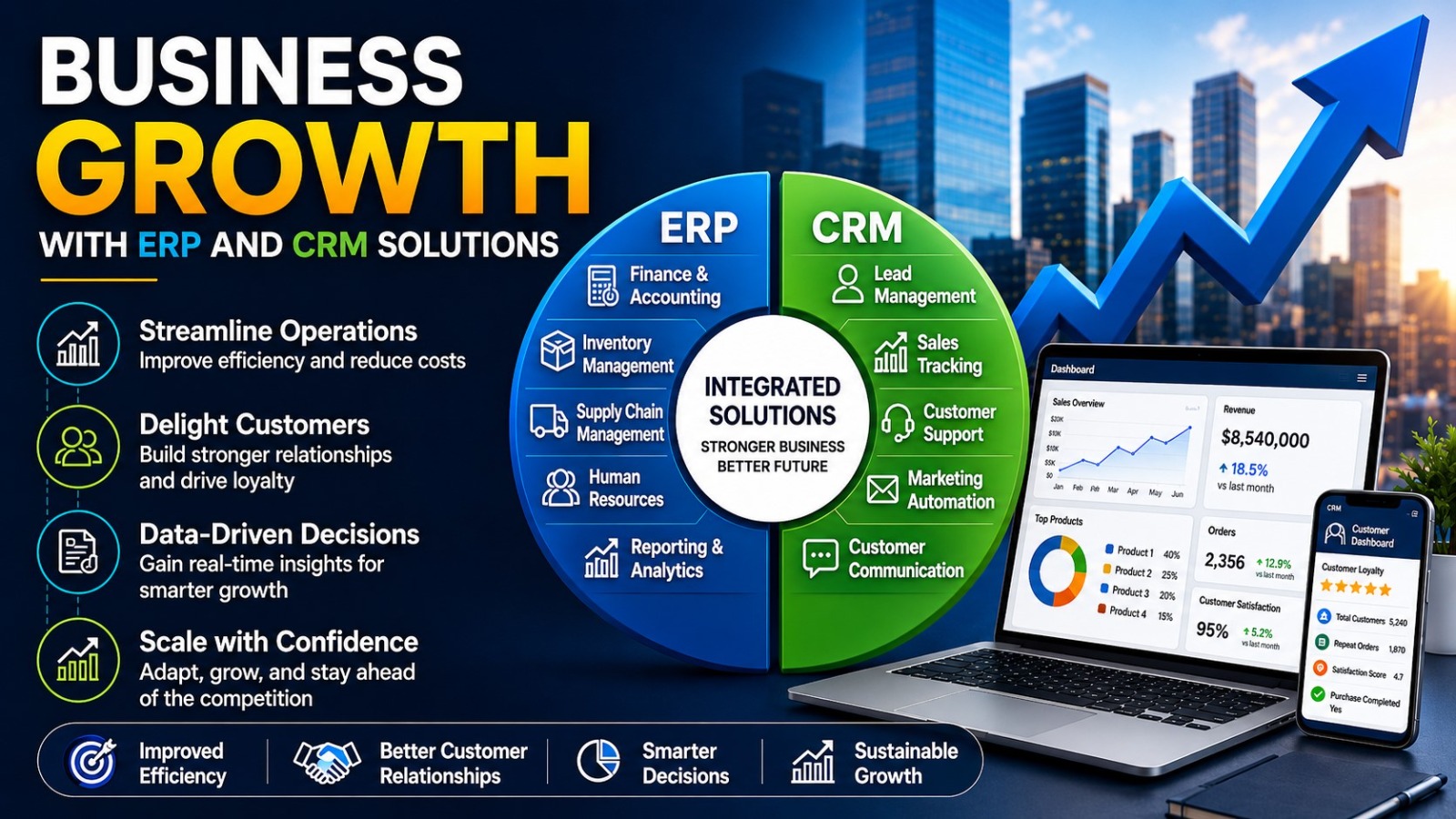
ERP consolidates different business functions into one singular system.
- Key Areas Managed by ERP
- Finance and Accounting
- Human Resources
- Manufacturing
- Supply Chain Management
- Procurement
- Inventory Management
- Reporting and Analytics
Benefits of ERP for Growing Businesses
Improved Operational Efficiency
ERP enhances operational efficiency by removing duplication and automating business functions, enabling staff to attend to other functions with greater value.
Better Decision-Making
Availability of dashboards and reports in real time on sales, inventory, finance, and all other business operations improves visibility and facilitates the right decisions at the right time.
Cost Reduction
With better resource management and removal of unnecessary operations, businesses may notice a decline in operational costs.
Scalability
The growth of the business doesn’t hinder the capabilities of ERP systems to accommodate more data and transactions.
Enhanced Collaboration
Working from one resource helps all divisions in the business to communicate and operate better.
Why CRM Is Essential for Business Growth
The swelling of an organization with ERP systems leads to better data and transaction management, but CRM is needed to further build beneficial relationships with customers.
Key Functions of CRM
- Lead Management
- Sales Tracking
- Customer Support
- Marketing Automation
- Customer Communication
- Performance Monitoring
Benefits of CRM for Growing Businesses
Increased Sales Opportunities
An automated lead tracker within a CRM system can help the sales team turn more leads into customers.
Better Customer Experience
With a CRM system, businesses can keep a historical record of all past support calls, emails, etc., for each customer. This enables businesses to communicate with each customer in a unique, personalized manner while also helping them to support the customer more quickly, as they already know the customer’s support history.
Higher Customer Retention
It is more profitable for a business to keep a customer than to gain a new one. A CRM system helps enhance the relationship with and the loyalty of the customer.
Improved Team Productivity
A CRM system can assist both the sales and support teams in focusing on the customer relationship by eliminating repetitive tasks.
Data-Driven Marketing
A CRM system provides businesses with the necessary insight and data to create a highly focused marketing campaign that is likely to lead to a successful outcome.
ERP and CRM: A Powerful Combination
Most businesses that use both ERP and CRM systems view these systems in silos. However, when used together, the true potential of these systems can be realized.
ERP + CRM Integration Benefits
- Unrestricted access to both customer data and operational data
- Improved future planning and more accurate predictions
- More efficient order processing
- Improved customer relations
- More sales potential
- Better and more accurate reporting
An example of what seamless integration of ERP and CRM systems looks like from the customer’s point of view is a sales representative who needs to close a sale and is looking at the CRM system. The representative can view the available inventory to fulfill the order, view the order history, and determine the status of the customer’s payment.
Signs Your Business Needs ERP and CRM
The following symptoms indicate it is time to invest in ERP and CRM.
- Business data is scattered across numerous spreadsheets
- The different teams in your business find it difficult to communicate
- Responding to customer inquiries takes an excessive amount of time
- You find it difficult to manage your inventory
- Preparing financial reports is burdensome
- You miss out on sales opportunities
- Business expansion is resulting in operational roadblocks
If these symptoms resonate with you, you should consider implementing ERP and CRM solutions to address your problem.
How Technology Accelerates Business Growth
Using technology not only improves the efficiency of your enterprise but also optimizes customer service. An efficient business equals a profitable business. The advantages you will gain include the ability to.
- Make better decisions in a shorter time
- Lessen the cost of doing business
- Deliver better customer service
- Increase the proficiency of your employees
- Recognize areas for growth before your competition does
The above goals become achievable with ERP and CRM solutions.
How ERP and CRM Solutions Transform Business Operations and Drive Sustainable Growth
Modern businesses use ERP and CRM systems to help them grow and run very efficient systems that interlink various departments. The best and most efficient way for businesses to run their systems and help grow their customer engagement base is by integrating their CRM and ERP systems. At that point, a business can manage its contact information, improve and manage support, and, most importantly, improve its customer experience. For the sales department, this will help make the best and most efficient sales process system, while also helping manage support requests through multiple support channels. Business leaders and managers that have access to real-time, comprehensive, and updated systems can easily and efficiently manage their project management and improve their systems and processes. ERP and CRM platforms can help both small businesses and large corporations save a lot of time and manual work by integrating a lot of tasks that can be done via AI power and other automated technologies into one system. This can help corporations improve their employee and customer experiences, and most importantly, it helps small and large businesses grow in the marketplace.
SUMMARY
Ambition alone will not drive the growth of your business. The right systems will enable you to achieve your goals. Increasing efficiency and strengthening customer relationships are growth drivers and core focuses of successful businesses. Streamlining processes and improving customer interactions is achieved through the implementation of ERP and CRM solutions.
The competitive landscape will only continue to grow more intense. Successfully implementing integrated business management solutions will help you achieve your goals. For established businesses, the implementation of ERP and CRM systems will significantly increase profitability and efficiency while improving the customer relationship focus of your business.